E N O U G H
Imposter syndrome at work: why capable people doubt themselves, and what it costs your organisation
A Keynote and Workshop by Dee Hunter
“We don't need to become more capable, but to recognise the capability we already possess, and stop questioning our right to own it.”
A conversation: The hidden cost of quiet self-doubt
Imposter syndrome rarely announces itself at work. It looks like the high performer working every weekend to stay one step ahead of being found out, the capable team member who stays quiet in meetings, and the manager who struggles to delegate because handing work over feels risky.
People living with it are unlikely to tell you they're over capacity, unsure or struggling, because saying so feels like confirming their worst fear. The honest conversation never happens, and the cost shows up later as burnout, stalled careers, declined promotions and good people walking out the door.
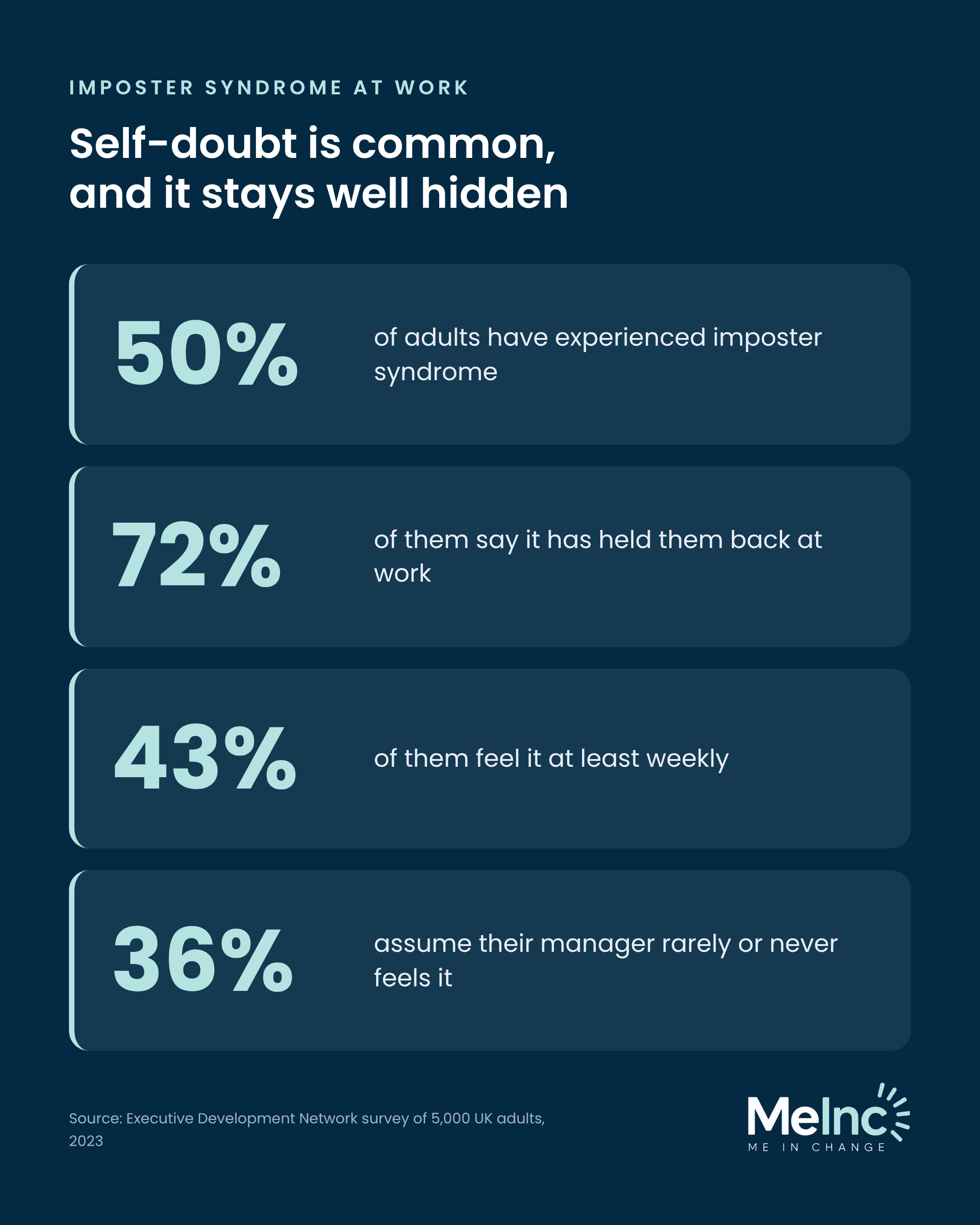
A 2023 survey of 5,000 UK adults by the Executive Development Network found half had experienced imposter syndrome. Of those, 72% said it had held them back at work and 43% felt it at least once a week. More than a third assumed their own manager rarely or never felt it, which shows how well hidden it stays.
In leaders, the impact travels further. A manager who quietly doubts their own place can find it harder to hire people more capable than themselves, give straight feedback or let their team shine. Self-doubt at the top shapes the whole team beneath it.
The Keynote
Where's The Evidence?
ENOUGH explores where imposter syndrome really comes from and why success alone rarely quietens it. Dee traces it back to the self-limiting beliefs we absorb in early childhood, shows how they're reinforced through school, adolescence and early working life, and explains why the workplace, with its reviews, promotions and constant visibility, is where they surface most sharply.
These beliefs are easily mistaken for character flaws. They are settings that were handed down to us, and settings can be reset.
Many capable people respond by building a polished, confident version of themselves for work, and keeping that up takes a great deal of energy. Drawing on research and her signature Deep Identity Shift approach, she unpacks seven core self-limiting beliefs and introduces the question at the heart of ENOUGH: where's the evidence?
Audiences leave understanding why capable people doubt themselves, with the language to talk about it openly at work. Leaders leave seeing the over-preparing, the silence in meetings and the yes to everything through a different lens. The deeper work of identifying and resetting those beliefs happens in the ENOUGH workshop.

The Enough Checks
Three tools, one conversation
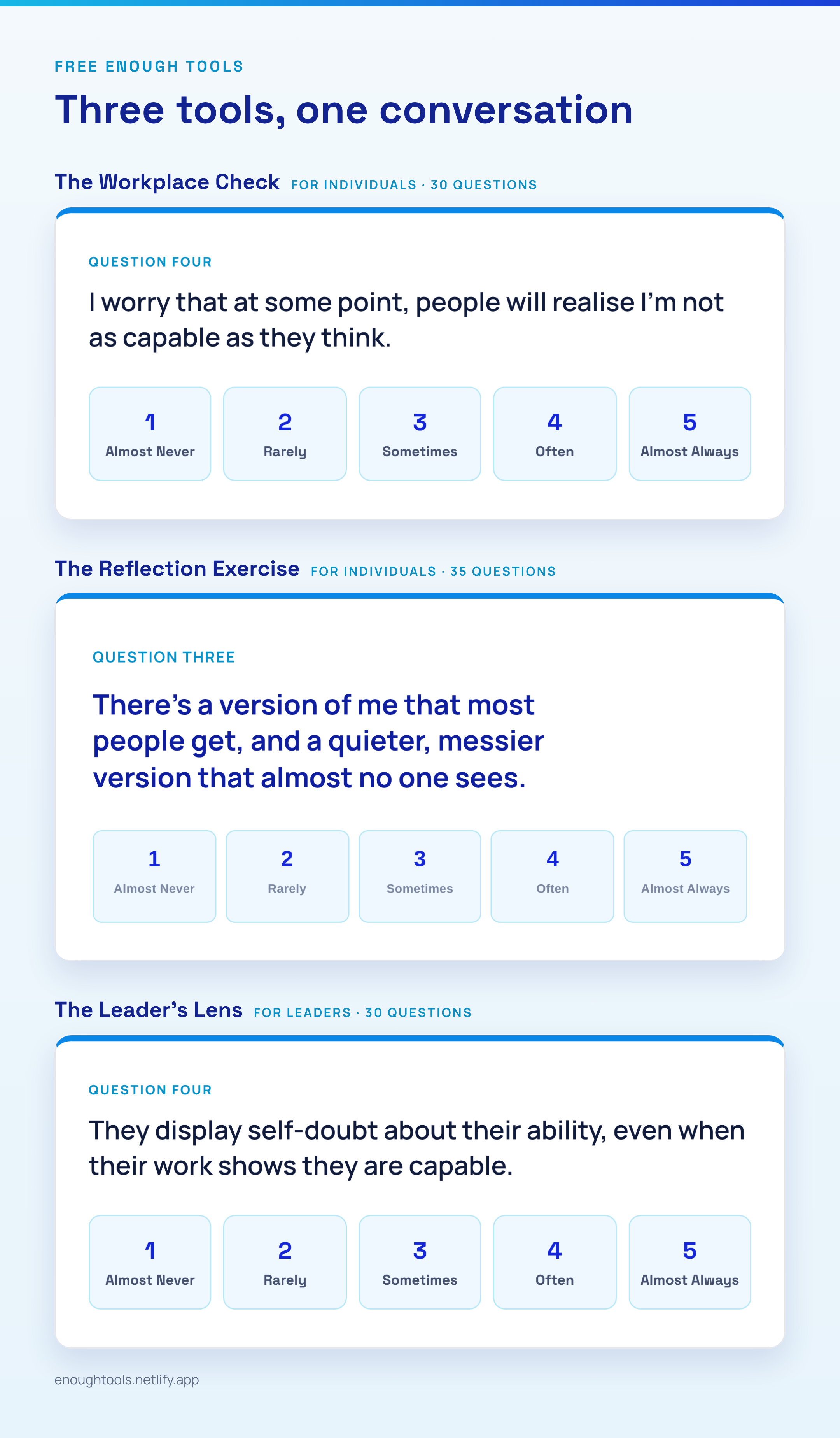
The ENOUGH Workplace Check is a 30-question quiz any individual can take to see the level to which imposter syndrome may be influencing their day-to-day work. The results belong to the person who takes it.
The ENOUGH Reflection Exercise goes a layer deeper. Its 35 questions help people uncover which of the seven core self-limiting beliefs are shaping how they work, so they can see the settings behind their patterns. It's a natural next step after the keynote and a strong starting point for the workshop.
The ENOUGH Leader's Lens is completed by a manager, looking at the behaviours they observe in a team member, such as over-preparing, holding back in meetings, reluctance to delegate or hesitation around new opportunities. It helps leaders notice what is easy to miss and open a supportive conversation.
When both people choose to take part, the two results can be compared to reveal the gap between how someone sees themselves and how their manager sees them. That gap is often where the most valuable conversation lives. Because this is personal, the comparison is always the employee's choice and is explored one-to-one in a coaching session with Dee, kept well apart from performance reviews.
The Workshop
From Insight to a new story
Four hours, in person or virtual
The workshop takes the keynote's question and gives people the time and structure to work with it. Because imposter syndrome is personal, the session is carefully designed for safety. Participants reflect privately in their own workbook, choose what they share, and are never asked to disclose quiz results or personal history. Managers and their direct reports attend separate sessions, so nobody works through self-doubt in front of the person who reviews their performance.
Inside the workshop
What we cover
What imposter syndrome is, and the impostor cycle first described by psychologists Pauline Clance and Suzanne Imes
Where self-doubt begins: the seven core self-limiting beliefs and how they are handed down in early childhood
How those beliefs are reinforced through school, adolescence and early working life
Why the workplace triggers them: reviews, promotions, comparison, high-pressure projects and constant visibility
The persona: the polished version of ourselves we build for work, and the energy it takes to keep it up
How imposter patterns show up at work, from over-preparing and overworking to deflecting praise, saying yes to everything and holding back ideas
The link between imposter syndrome, stress and burnout
Where's the evidence? Testing self-limiting beliefs against real moments from participants' own working lives
Resetting the settings: reframing self-limiting beliefs and building a new story
A simple practice for the moments that trigger self-doubt, so the change holds after the session
For leaders: recognising the signs in a team, using the Leader's Lens and opening supportive conversations
Adaptation as a practical skill, and the cost of operating with old expectations in a new environment
The nervous system: the accelerator and the brake
The neuroscience of stress and how it alters cognition, focus, emotional regulation and decision quality
The physiology of stress and cortisol control, and the impact of sustained load on metabolism, immunity, mood and long-term health
Stress and anxiety, and how short, medium and long-term stress accumulate
The brain-body connection, and why stressed states cannot be shifted through mindset alone
Early stress signals, and how to intercept escalation before momentum builds
Sleep, memory, circadian rhythm and the cost of operating out of sync with the body
Digital discernment: the attention economy, open loops, constant connectivity and micro-urgency
Recovery that fits real working lives, values alignment and the science of lasting behaviour change
Your people leave with
An understanding of where their self-doubt comes from and how it shows up in their work
Insight into which of the seven beliefs are most active for them
A practical method for testing self-doubt against evidence
Language to talk openly about confidence, capacity and self-doubt
The ENOUGH workbook and a personal plan to keep working with it
Every participant takes home the ENOUGH workbook, and all resources are shared with the organisation for follow-up communication. Integration coaching is available for individuals and for manager and team member gap conversations.
A workshop for women
ENOUGH is also available as a women-only workshop. Women report imposter syndrome more often than men, and for many it sharpens in midlife, when changes in energy, focus and memory can leave capable women questioning whether they can still work at the pace they once did. Too many step back or leave just as their experience is at its most valuable. This session gives women a safe space to understand what's happening, separate their worth from their output, and take their place with confidence.
"Imagine what people could achieve if they stopped treating inherited beliefs as personal flaws and started recognising them as settings they have the power to change."
What your organisation gains
ENOUGH helps people speak up earlier, step into stretch opportunities, delegate and ask for help before they're overwhelmed. Leaders gain the language and tools to recognise self-doubt in their teams and respond with understanding. The result is more honest conversations about capacity, confidence and growth, and a culture where capable people can finally believe they belong in the room.
Bring ENOUGH to your organisation
Keynote 55 Minutes
Workshop 4 Hours
Integration Coaching
What clients say

I’ve never seen a speaker hold an audience so captivated for over an hour, leaving us wanting more. Dee’s storytelling and insights have depth and she truly knows her stuff. I hope Dee offers this as a half-day workshop, as members are eager for more!
Cathy Horton, Events Manager, The Northern Club, New Zealand
Dee delivered a hybrid presentation to our 250 staff nationwide, addressing real stressors they face. She gave us clear insights into stress and management techniques, handled numerous questions, and provided an excellent summary with resources afterward.
Nastasia Belz, Events Co-ordinator, Tompkins Wake Legal
Dee opened our two-day conference in Auckland, and we then asked her to close the same conference in Sydney. The reviews speak for themselves: a total score of 4.8/5, and she set the tone for the whole conference. “Engaging and informative, wonderful speaker.” “Humble and generous, what a great journey we went on.”
Anna Turner, Portfolio and Content Director, HR/L&D Tech Fests, Sydney
Recent Clients and Events